Following on from the series of Harajuku Punks that I did before , way back in 1995 here is a more recent description. The coat she was wearing was everywhere amongst Tokyo’s youth culture late last year but knowing how transient and disposable Japanese society is they are probably all in the bin now.
It’s acrylic on canvas
click on the image for a larger view
September 16th, 2009


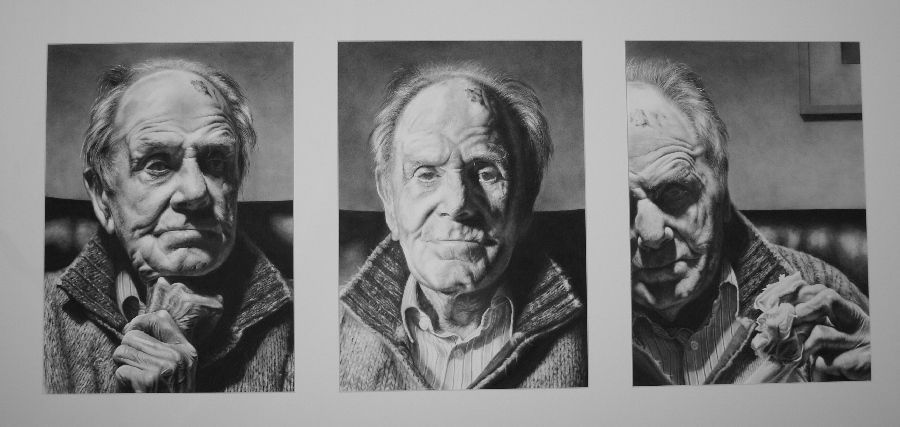
It sems like an eternity ago now but around 18 months ago I enterd my portrait of “Ronald” into the Wales Portrait Award 2, which is basically a carbon copy of the BP Portrait Awards in London. It’s a great exhibition and very professionally done with an excellent catalogue and prizes , again, similar to the BP. It basically stipulates that all of the artists haveto be Welsh or working in Wales or of a Welsh sitter – ( where my portrait qualified).
As in all of these competitions the visitors choices are inevitably different to the judges selections. All visitors are invited to write down their favourite portrait during the 18 month tour and luckily for me Ronald came top which I was delighted about , so thanks to all that voted , I’m just pleased that Ronald made such an impression / connection with people.
Here’s a picture of me with an oversized “lottey” style cheque which I took to the bank but couldn’t get under the counter. Just to the left hand side of th image is Peter Edwards’ portrait of Ryan Giggs , but unfortunately you can only just see his shoulders, sorry Peter.
The exhibition is at it’s 6th and final venue Rhyl Museum and Arts Centre until 19th September. I hadn’t been to Rhyl for years. My Grandad used to have a caravan there in the 1970’s and we used to go on family holidays up the A5 so the visit brough back a lot of memories too.
September 6th, 2009

Here is my latest , another portrait of Isao Suzuki in Tokyo, (see previous posts). This time in profile with a compositional bias towards the right hand side. It was an incredibly dingy jazz club, just a small black room with posters pealing off the wall and junk pilled up on the bar with about 20 seats positioned infront of the stage. I wanted to get a bit more of the atmosphere of the space so I included the back wall of the stairs.
(click on the image for a larger version)
September 6th, 2009


I met Isao Suzuki in an underground jazz club in Tokyo -(underground both physically and musically). My friend from my old foundation course, Anthony lives in Tokyo, though has since returned, and we met up and he took us to the club and arranged a sitting with Isao.
He’s in his 70’s now but is still “rockin’ out ” and very generously playing with a young band, taking a back seat, who I think keep him feeling young. He lived in New York towards the end of the golden age of American Jazz in the Late 60’s and early 70’s and played with such giants as Ella Fitzgerald, Theolonius Monk, Charlie Mingus and was one of Art Blakey’s Jazz Messengers for many years, Art being the person who initially invited Isao to America to play in his band.
I wanted to capture “in the moment” as he was playing, again using the dark background to focus full attention on him.
(click on the images to enlarge, the last one of the finished image should come up biggest )
August 6th, 2009

Here is a new picture of a trader that I met a Tsukiji fish market in Tokyo, one of my favourite places ever. It’s got the sketcy background which I find incredibly liberating to do set against the photorealistic portrait. I particularly liked his beard and of course his bandana, any kind of head adornment in a portrait and I’m there. I think this was around 28″ long.
(click on the image for a bigger picture)
August 6th, 2009

Here is a very recent portrait commission of a lovely lady from my home town, Walsall. It is acrylic on canvas and is aproximately 36″ x 32″.
We took a huge number of photographs looking at about 23 different compositional possibilities and for quite some time they didn’t seem to be working just how I had intended. Then the final series of shots that I took just seemed to work perfectly, the pose was just right, expression, mood all came together. I’m so glad that I pushed it right to the end in the photography stage because we could easily have gone for something that didn’t quite work. I like to use space in my portraits because there is often so much detail in the portrait that it needs the space to resonate against and rest and it focuses the attention more on the figure with no distractions. It’s nice to be working in colour again too because I’ve done a lot of B/W paintings and drawings lately. This is the first of a pair of portraits. I will also be painting Christine’s husband who is a Reverend in his church with all the decorative and ornate possibilities of the space.
(click on the image to enlarge)
August 6th, 2009


Artists and Illustrators Magazine – Summer 2009 – issue 276
It is an unedited transcript of the interview which I did with the magazine which is in the shops now.
1. What prompted or inspired your self portrait ?
I was 39 and fast approaching 40 and I thought that it was a good time to make a series of self portraits. I’ve always been equally as interested in photography as I have in painting and drawing and it is a strong element to my work. I took series of around 200 photographs under various lighting conditions , poses and states of dress to see which would work best. This was a very spontaneous one, I saw my wife’s winter “Pixie” hat and just grabbed it and our dog, Max, came into the kitchen sniffing around and jumping up , wanting to get in on the act, and forced his way into the composition.
2. Do you approach a self portrait differently to a standard portrait ? And are you self critical ?
In some ways I approach self portraiture in the same way that HG. Well’s “Invisible Man” experimented upon himself in the laboratory. I think when you work with yourself you’ve got cart blanch to do what you like and push it in whatever direction you like which is why self portraiture is so liberating artistically.
I have previously pretended to be Jesus at the age of 33 ( Pretending to be Jesus – 33- 2003) when he / I was entombed and resurrected ( both “dead and risen”) in a diptych self portrait. In 1994 I did another diptych called “The Obscurity and Revelation of Andrew” where I was depicted with naked torso and soap on my face. Certainly my commissioned portraiture is more conservative , unless the client is particularly open minded. I am also a stickler for detail and I would never try to flatter myself in any way , so every one of my 40 years is in this latest self portrait which I hope gives it an honesty and realism which really is the whole point of doing a portrait at 40.
3.What are your first memories of art or painting ? And did any of your family have artistic leanings ?
When I was young I just drew with half running out felt tip pens in old diaries like any children would. I attached no significance to it other than it was something to do and allowed my imagination to run loose drawing monsters and World War 2 battle scenes. Around the age of 13 I felt that I would quite like to be and artist though I was very average at school and to this day I don’t know how that thought materialised , there was certainly little conviction behind it at that time. My uncle was a graphic designer and I remember visiting his design studio around the same time and thought it was a great set up, though I had little interest in designing boxes for Boots or Marks and Spencers. My father worked in the steel industry for most of his life and my mother was a doctors receptionist so there was no clear lineage.
4. Looking back, do you think your background in illustration has been a help or a hindrance in your art career ?
At the age of 18 I still wanted a career in art but I suppose I had my sensible head on and after careers advice felt that Illustration would be a more commercially viable option than an “artist” so initially I went down that path. Towards the end of my degree at Birmingham I knew that I hated the idea of commercial Illustration and waiting around for an agent to call me to paint a sterile picture which I had absolutely no interest in. I did my MA at Birmingham, mascaraeding as “Illustration” it was, in fact a social documentary project which examined the “De-Industrialisation of the West Midlands Steel Industry”, visiting the last foundries, chain makers and hot press rolling mills in the Black Country and making a series of portraits of the steelworkers. It was exactly what I wanted to do. In some ways I’m glad that I did Illustration because at this time, the early 90’s, Conceptual art was high on the agenda , to the point of indoctrination in some art colleges and I knew that I didn’t feel comfortable with way of working either. It’s always been figurative art and portraiture which I’ve been interested win and has proved endlessly enduring and stimulating for me for the past 17 years or so. There is endless potential in portraiture because – “people are interesting“. It’s a simple premise but as each year goes by this feeling becomes stronger within me and I know that it will always be that way.
5. Who has been your most interesting sitter and is it important to establish a rapport with each of them or identify with them in some way ? For example , would you read Cormac McCarthy’s book before painting him ?
I have been fortunate to have painted some very significant figures in my career so far but to me it is always “ordinary” people who are the most interesting; Old steelworkers and shipbuilders, pigeon racers, people on allotments, Tokyo fish market traders , Hells Angels, Native American Indians, Vietnam veterans, First World War veterans, grandparents, my wife. The people that you can’t google or research – you just meet them and build up a rapport and the resulting work is the product of conversation and blind faith.
6. Did you enjoy your time in New Mexico and did it alter your perspective in any way ?
New Mexico is such an inspiring place for portraiture because it has such an authentic, and bohemian feel and is full of interesting characters like the Native American Indians, original hippies who first settled there in the 60’s, Vietnam veterans who dropped out there, cowboys, artists, authors, scientists and musicians.
For me the best thing about my New Mexico project was the re discovery of drawing. I started to make portraits in charcoal and felt that I could produce work reasonably quickly, which, most importantly, I was very pleased with. It was a liberation because I have spent up to 12 months on one painting in the past and I had suddenly found a way of putting down ideas and portraits which passed my “quality control” in a more immediate way.
7. You recently returned to Japan too, will you be working on a project similar to your one in 1995 ?
When I won the BP Travel Award in 1994 and went to Japan and loved it so much that I always wanted to return so last November I went back on an inspirational trip to find new portraiture based subject matter. My project will focus on “Tokyo Portraits” depicting a whole cross section of Japanese society including; the Buddhist monks of Kamakura, Tsukiji Fish Market Traders, the homeless population of Ueno- Koen, the incredibly flamboyant Harajuku Punks and Rockabilly Greasers of Yoyogi Park, market traders from Asakusa, café and sushi restaurant culture of Tokyo, the nightlife of Shinjuku and the Golden Gai, Musicians that I met in underground Jazz and rock clubs, children and women in traditional Kimomo dress, street performers and the wealth of people that I just met in the street. I’m just quietly and very enthusiastically developing this work at the moment alongside my commissions.
8. Many portrait painters concentrate on the sitter alone, though you seem keen to bring in wider concerns . Would you agree and if so , do you think that is part of your responsibility as an artist ?
In terms of my portraiture and “wider concerns” I like to define a series of portraits loosely within a kind of social documentary project – like “The de-industrialisation of the West Midlands steel industry” or “The cradle to grave work ethics of the Japanese car manufacturing industry” and explore portraiture within a specific framework. I look for situations where the effects of daily life impact on people and attempt to portray my findings in an accurate, narrative and sympathetic way through portraiture.
Objects are also important in my portraits, I like the way that objects reflect and reinforce the sitters identity. For example the objects which surround Tony Benn and Neil and Glenys Kinnock in my portraits of them hold some intrinsic narrative or memory or sentiment. I have always loved Holbein’s – Ambassadors and saw both Neil and Glenys as Ambassadorial figures taking that painting as a big influence on my portrait. Sometimes the sitter alone is fine too, objects can look a little staged and formal if you are not careful and the power of a single head can be extremely profound in the right hands. When my grandparents died I did a large diptych, on one side was an empty room from their house and on the other were 26 banal objects which used to be in that room. It was about the way objects and spaces provoke memories and suddenly become very significant. Even though there were no people in the painting I still saw it as a portrait.
9.Were you an admirer of Lucian Freud before you painted Kitty Godley and were you nervous given the connections ?
I was an admirer of Freud but certainly not an obsessive which people might think , given my interest in Kitty. I remember seeing his show at the Whitechapel gallery around 1992 with those wonderful portraits of Leigh Bowery and loving them but knowing that I would never paint as spontaneously has him.
Kitty’s father was Jacob Epstein and their family left their art collection to Walsall Museum and Art Gallery , ( my local gallery) in 1972, having lived locally. There is a wonderful portrait of Kitty in the collection by Freud, painted in 1948 soon after they married. I had always admired it and wondered if she was still alive. As the years went on it was always at the back of my mind to try and catch up with her if she was still alive so I thought if I’m going to do this I’ll have to do it soon so I contacted her through the gallery and arranged a sitting. I think really the project was more about both mine and Kitty’s links to Walsall than it was about Freud. Looking back I should have been so much more concerned with treading the same path as a giant like Freud but it honestly never crossed my mind. I just had an idea and once I focus on something everything else just goes out of the window.
10.Apart from art, what is your greatest talent ?
I do dislike the term “talent”, (I’ve noticed that politicians have appropriated it to their trade more recently) It cunjours up some kind of shamanistic, mystical qualities when I honestly believe it’s in us all if we can tap it out in some way. If I were to pinpoint something then, for me, I think that it would have to be “optimism” . If you hope to have any career as an artist you have to look on the bright side of life and have blind faith in what you are doing. I’m also good dog walker.
11. What do you think your studio would say about you as a person and do you have any rituals or routines when you work ?
I have to listen to the radio all day, primarily radio 5 during the daytime with its current affairs style shows, ( not the sport which I hate) . I also like radio 4, 6 and 7 and am constantly flicking around all day. Studio practice is quite isolating and the radio is a great companion. I generally paint on auto pilot so it never intrudes. I tend to think of myself as being quite ordered and organised but looking at my studio at the moment it’s more Steptoe and son than Bang and Olufsen.
12.Who or what is currently exciting you artistically ?
At the moment , personally it’s drawing, painting in monochrome and Japan and always portraiture.
13. Do you still find art difficult and if so why ?
It sounds rather arrogant but I’ve never found painting and drawing difficult. Maybe it’s because I have certain ways of working which I have fine tuned over the years and I know instinctively how to work now and get the results that I’m after… just experience really I guess. Ideas come flowing daily while I’m walking Max or out and about, (rarely in the studio), and I record them onto a dictaphone and jot them in my sketchbook when I get back. I give them the 6 months fermentation process and decide if they are still good ideas half a year later.
14. What ambitions do you have ?
For about 14 years my ambition was to win the BP Portrait Award and I chased it year after year. It’s the only competition that I have been obsessed with , probably because it is so uniquely linked to the kind of work that I do and also because the National Portrait Gallery is such a splendid institution. Once you’ve won you can’t enter again and I must admit I do miss that. It encouraged me to do one piece of personal work each year that I hoped was a little more edgy and special and anything which encourages that must be a good thing.
I’d like to find more of a comfortable balance where my personal work outweighed my commissioned work because there is so much that I want to do. I’d also like to spend 6 sunny weeks on a narrow boat slowly travelling around Britain with my wife and our dog just working on smaller scale pictures as we drift along.
July 9th, 2009

This is my new drawing called “Ueno”. Ueno is one of the districts of Tokyo and this particular scene is set in Ueno park which is a beautiful park full of shrines and temples and a magnificent zoo which Anne and myself walked around.
I wanted to get a flavour for the place so I depicted the main ancient temples Benten-Do temple which is dedicated to Benzaiten, the Buddhist goddess of the arts, wisdom, the sea and protector of children, ( so she covers a lot of ground). The temple is perched on a wonderful man made island ad surrounded by a lake full of huge water lilly pads with lots of beautiful dragon flies darting around. The Kiyomizu-Do temple in the picture is where women wishing to conceive a child leave a doll for Senju Kannon, the goddes of mercy, and the accumulated dolls are ceremonially burnt each 25 September.
There are a lot of homeless people living rough in Ueno park in perfectly ordered cardboard box constructions and blue sheeting. They even brush dust away from their shanty towns with little brushes and pans. The homeles population are notorious for looking after the hundreds of cats that live alongside them in the park. So, the guy at the front of the drawing was a homelss guy that I met and there are others dotted around in the composition together with fashionable Japanese youngsters who were also in the park walking around or making calls on their cell phones. There were also quite a lot of Buddhist monks standing around holding rice bowls and chanting waitng for donations to wrattle in thei rice bowls.
I have always loved the extended landscape compositions of the ancient Japanese paper scrolls which sometimes stretch out for 20 feet. I wanted to get something of the quality of line which is found in Japanes art from these ancient illustrated ink scrolls to contemporary Manga coupled with my usual realist style. I was trying to isolate sections of the picture juxtaposed to white space and line which seems to push out the figures against the background whilst giving them a context.
If you click on the image, I have loaded up a large version of the drawing so you may haveto wait a minute for it to load but you can have a good scroll arouund the drawing.
June 20th, 2009


Here are the roughs for my latest drawing from the “Tokyo Portraits” series. I’ll explain more about the image in the following posts. As usual, my design process starts with walks and thoughts recorded onto a dictaphone as I walk our dog Max. Walking is really furtile territory for me and as usual ideas come whilst strolling along and rarely ever in the studio which is why I always carry a camera and dictaphone because I’ve normally forgotten ideas by the time I get back.
I then start writing down words and justifying everything over a period of weeks and months whilst I am working on other paintings and drawings, just thinking about it really – what is the picture actually about? I see this as the fermentation or gestation period and if an idea still seems good a few months later then I’ll go for it.
Previously I’ve done roughs in the traditional way with pencil and paper and then squared them up which also works perfectly well ( see my website for examples). More recently I’ve been using a simple photoshop programme which is fantastic for juxtaposition and working out scale and spacial areas before I go head first int the image. It can be quite time consuming for me because I’m a bit slow on the uptake with computers and the procedure is very repetitive but it’s worth while , though I’m sure others would say it saps the spontenaety out of a painting.
Here are a few examples , just click on them to enlarge.
June 20th, 2009
Next Posts
Previous Posts